

Automotive infotainment PCBA powers the central control, navigation, audio and connectivity modules in a vehicle. Kilandu builds these boards on an IATF 16949 certified automotive line with BGA and fine-pitch assembly, conformal coating and functional test, for OEM and Tier-1/Tier-2 buyers in Europe, Russia and the Americas.
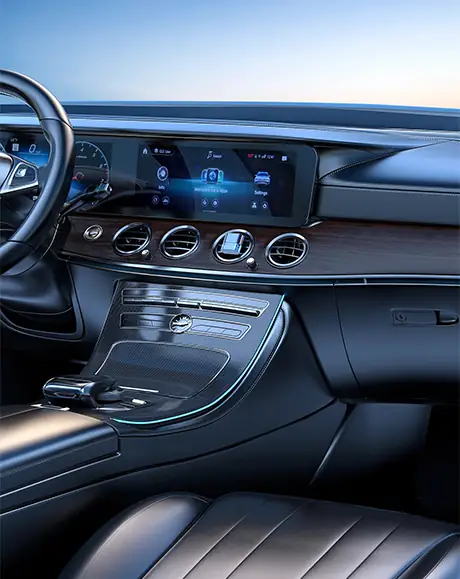
- Central control and head-unit boards
- Navigation, audio and connectivity modules
- BGA and QFN down to 0.3 mm pitch, 01005 placement
- Conformal coating for the in-vehicle environment
- IATF 16949:2016 certified
- IPC-A-610 Class 2/3
Capability
What Kilandu can build, test and ship for this product family.
| Parameter | Capability |
|---|---|
| Board type | 4-20 layer rigid / rigid-flex |
| Components | BGA, QFN, 01005, connectors |
| Testing | AOI + ICT + functional + burn-in |
| Protection | Conformal coating / potting |
| Standard | IATF 16949:2016 |
| Lead time | 2-5 weeks |
Applications
The infotainment modules we assemble.
- 01
Central control and head units
Main boards carrying the SoC, memory and display interface for the head unit, where dense BGA routing and controlled impedance matter.
- 02
Automotive audio and amplifiers
Audio processing and amplifier boards with thermal design suited to a dashboard environment.
- 03
Navigation and telematics
Positioning and telematics control boards with shielded RF sections and stable power rails.
- 04
In-vehicle connectivity
Bluetooth, Wi-Fi and cellular module boards assembled with module placement and an antenna-friendly layout.
- 05
Rigid-flex and space-constrained layouts
4 to 20 layer rigid and rigid-flex boards for enclosures that force a folded or stacked layout.
Certifications and compliance
Certificate numbers are published so your sourcing and audit teams can verify them directly.
| Certification | Certificate number | Issued by | Valid until |
|---|---|---|---|
| IATF 16949:2016 | IATF No. 0596984 - IATF USI L3A259 - ZA-FCAV No. 2600270/R0S | Beijing Zhong An Zhi Huan Certification Center Co., Ltd. (DBA: Zhong An FCAV International) | 8 Feb 2029 |
| ISO 9001:2015 | CN27125Q0392R0S | Guangdong ZQ Certification Service Co., Ltd. (CNAS C271-M) | 29 Jun 2028 |
| ISO 14001:2015 | CN27125E0142R0S | Guangdong ZQ Certification Service Co., Ltd. (CNAS C271-M) | 3 Aug 2028 |
Kilandu (Shenzhen Jintianlei Innovation Technology Co., Ltd., unified social credit identifier 91440300312061769E) manufactures automotive PCBA under an IATF 16949 certified automotive quality management system.
The IATF 16949 certificate covers the manufacturing of printed circuit board assemblies (PCBA) and excludes product design under clause 8.3, so design authority stays with your engineering team while process control, traceability and change management are audited to the automotive standard.
How we build it
From solder paste to tested board, inside our own factory in Bao'an, Shenzhen.
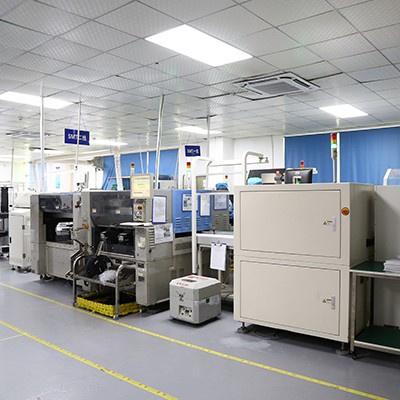
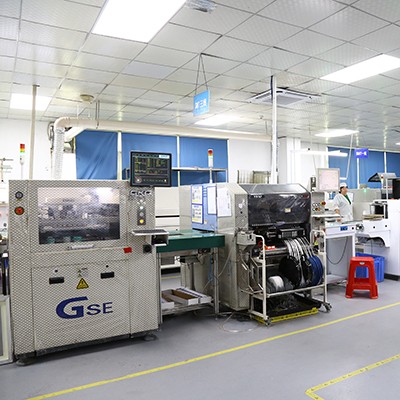
SMT assembly
01005 chips up to BGA and QFN placed on automatic high-speed SMT lines and reflowed with lead-free paste.
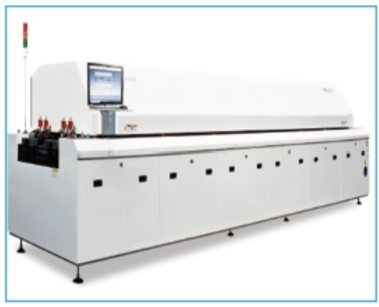
Reflow and wave soldering
Lead-free reflow for SMT, plus automatic DIP lines with lead-free wave soldering for the through-hole parts.
AOI, X-ray and ICT
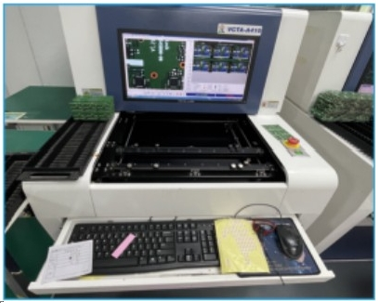
Automated optical inspection on every board, X-ray for BGA and hidden joints, and in-circuit test on fixtures built to your netlist.

Functional test and traceability
Functional test against your own specification, with traceable inspection records issued for every batch.
What an infotainment board demands of the process
Thermal load, connectors and radio performance in one assembly.
Thermal load in a dash-mounted unit
A head unit sits in a closed space behind a display, often with no fan and with the sun on the other side of the glass. The board has to move heat out of the amplifier and the processor into the chassis rather than into the air around it, which means thermal vias, copper area and the way the board couples to its housing are decided at layout. At assembly the consequence is a reflow profile set for a board with heavy internal planes, and a heat path specified as one item rather than as a board problem and a mechanical problem.
Connectors, displays and flex
An infotainment assembly carries more interface hardware than most boards: board-to-board connectors, FPC and FFC connectors for the display and touch panel, USB and LVDS wiring, and often a rigid-flex section where the board folds into the housing. Fine-pitch connectors are placed and inspected to the same standard as the components around them, and where a flex tail or a display interface is part of the finished unit, it is fitted and tested in the same work order rather than shipped separately.
Keeping a build radio-quiet
Where the unit carries a tuner, a GNSS receiver or a cellular module, the assembly has to protect the radio path as well as the solder joints. That means controlled-impedance lines kept as designed, shielding cans placed and grounded correctly, and cleaning and residue decisions that do not shift the behaviour of the board around the antenna feed. These are process decisions taken against the design, not properties added at test.
From a first sample build to series production
What changes between the sample and the series lot, and what deliberately does not.
Infotainment programmes move quickly, and the risk is not the first build but the tenth: a sample built on one line, with one fixture and one inspector, says very little about what a series lot will look like. The approach here is to keep the process constant and let the quantity vary, so the sample and the series lot are the same build at different volumes.
What changes between samples and series
Quantity changes the material plan, the number of fixtures and the way test time is spent, and those are planned per programme. The process route does not change: the same SMT and through-hole lines, the same SPI + AOI + X-ray in-process inspection and the same ICT + FCT electrical test are used from the first lot onward, so there is no second qualification when the volume arrives.
Handling a display or touch interface on the line
Where the finished unit includes a display, a touch panel or a mechanical sub-assembly, those are fitted and tested in the same work order as the board rather than handed to a third party. That keeps the interface between the electronics and the mechanics inside one process record, which is what makes a fault on a returned unit traceable to a single operation instead of two.
Keeping a change-over cheap
Consumer-facing products are revised often, and a revision should cost the programme a new Gerber and BOM, not a new supplier. Because the same lines run both the current and the revised build, a change is absorbed as a new work order with the same fixtures where possible, and the previous configuration stays on file for the service and spare-parts volumes that usually follow.
Frequently Asked Questions
Quick answers to what buyers ask us most about this product family.
Are your automotive PCBAs IATF 16949 certified?
Yes. Our automotive line is certified to IATF 16949:2016 (IATF No. 0596984, IATF USI L3A259, ZA-FCAV No. 2600270/R0S, issued by Zhong An FCAV International, valid to 8 Feb 2029). The certificate scope covers the manufacturing of printed circuit board assemblies (PCBA) and excludes product design under clause 8.3. Full build documentation is supported for Tier-1 / Tier-2 sourcing.
Can you handle BGA and fine-pitch components?
Yes - AOI + X-ray inspection for BGA/QFN down to 0.3 mm pitch, with 01005 placement capability.
Do you support turnkey automotive assembly?
Yes - SMT, through-hole, box build, conformal coating, and functional testing under one roof.
Send us your Gerber and BOM
We will come back with a turnkey quotation - PCB, components, assembly and test - usually within one working day.